Metal RFID Cards Metal · NFC · RFID Dark technical metal
Metal material page

Titanium Gunmetal RFID Cards

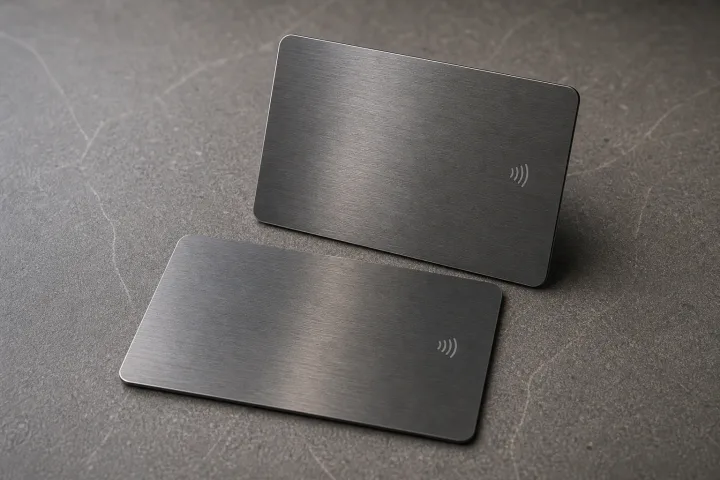
Titanium and gunmetal finishes are the understated technical route. They suit elite access, automotive, security, aerospace, technology, and executive programs where the card should feel precise, durable, and serious.

Executive, automotive, security, and technical-brand NFC cardsElite access cards with restrained dark metal identityWhite ink, light laser marks, QR, UID, and serial programsSample kits where graphite tone and edge feel matterPremium batches that should avoid bright gold styling
Titanium Gunmetal RFID Cards
(02) — RFID construction

Titanium / gunmetal RF build notes.

Most gunmetal programs run as dark brushed PVD over stainless — the titanium look with steel economics — while solid titanium builds are quoted separately as special projects. Either way the card is conductive metal and the antenna needs its engineered path: ferrite or hybrid shielding, tuned to the final thickness, then proven on the real reader. The graphite tone is the quietest in the range, which is exactly why data zones get light panels — grey-on-grey fails the scan test.

(03) — Print and marking

How the metal surface behaves.

Gunmetal rewards light marks and quiet graphics. QR and barcode zones use white or light panels — grey-on-grey data is unreliable, and that rule is enforced at the scan test, not discovered after delivery.

(04) — Uses and finishes

Where Titanium / gunmetal makes sense.

Every metal RFID card should be approved as a real stack: metal body, chip, antenna, ferrite or shielding route, marking method, edge, encoding, and packaging.

Best for

  • Executive, automotive, security, and technical-brand NFC cards
  • Elite access cards with restrained dark metal identity
  • White ink, light laser marks, QR, UID, and serial programs
  • Sample kits where graphite tone and edge feel matter
  • Premium batches that should avoid bright gold styling

Finish options

  • Titanium-look, gunmetal, graphite, or dark brushed PVD finish
  • Laser engraving, light UV marks, white panels, and subtle patterning
  • Dark RF edge or hybrid shielding by sample
  • QR, barcode, UID, and serial zones with scan approval
  • Technical sleeve or rigid sample-kit packaging
Card size CR80-style 85.6 x 54 mm, custom shapes by RF review
Base build Dark brushed PVD over stainless as standard; solid titanium quoted as a special project
Thickness 0.3 mm to 0.8 mm depending on construction
Minimum order None — single samples to production runs
Production time About one week after artwork and sample approval
Visual character Cool graphite gunmetal with restrained brushed highlights
Surface feel Dark technical metal face with low-to-medium reflection
Best contrast Light laser marks, white ink, subtle grey patterning, black edge
QR / serial Use printed contrast panels and approve scan distance on the finished sample
RF route LF, HF/NFC, standard and high-security HF routes, selected UHF by reader test
Reader approval Test against the exact phone, lock, gate, or desktop reader
Edge options Rounded CR80 edge, chamfer control, dark RF layer by build
(FAQ) — Common questions

Titanium / gunmetal: what buyers ask.

01Are titanium gunmetal cards solid titanium?

The standard build is a dark brushed PVD finish over stainless, which delivers the titanium look with proven card economics. Solid titanium constructions exist but are quoted as special projects with their own sampling.

02What are gunmetal RFID cards best for?

Executive, automotive, security, aerospace, and technology programs where the card should read as precise and understated — the graphite tone is the quietest premium signal in the range.

03Why do gunmetal cards need light data panels?

Because grey-on-grey does not scan reliably. QR, barcode, and serial zones use white or light printed panels, and the scan is verified on the finished sample at working distance.

(06) — Quote Titanium / gunmetal

Send quantity, chip, finish and encoding requirements.

Engineered antenna pathFerrite or hybrid RF structureLaser and deep engravingBrushed, plated, coated finishesUID, NDEF, and access encodingSample kits and production approval