Metal RFID Cards Metal · NFC · RFID Brushed red metal
Metal material page

Copper RFID Cards

Copper metal RFID cards are distinctive and limited-edition by nature. They work best when the buyer wants warmth, rarity, and a strong material signal for events, clubs, product authentication, gifts, and premium sample kits.

Limited edition event, club, and invitation cardsProduct authentication, collectible, and gift programsHospitality and retail activations with a warm metal identityLaser marks, dark UV print, QR, UID, serial, and NFC iconsSmall premium batches where color is part of the story
Copper RFID Cards
(02) — RFID construction

Copper RF build notes.

Copper is the most electrically conductive face in the catalogue, and the RF answer is the same disciplined one: shield, tune, test — the finished construction is proven on the target reader like every other build. What sets copper apart is its surface life. It oxidises faster than any other face in the range, so the protective clear route (or the decision to let it patina) is agreed on a physical sample, and dark marks with white QR panels carry the data reliably through that changing tone.

(03) — Print and marking

How the metal surface behaves.

Copper shifts visually with light and age, so artwork is tested as a finished sample rather than a screen proof. Dark marks and white QR panels give the most reliable contrast across that living surface.

(04) — Uses and finishes

Where Copper makes sense.

Every metal RFID card should be approved as a real stack: metal body, chip, antenna, ferrite or shielding route, marking method, edge, encoding, and packaging.

Best for

  • Limited edition event, club, and invitation cards
  • Product authentication, collectible, and gift programs
  • Hospitality and retail activations with a warm metal identity
  • Laser marks, dark UV print, QR, UID, serial, and NFC icons
  • Small premium batches where color is part of the story

Finish options

  • Brushed copper or red-metal PVD finish
  • Laser engraving, dark UV print, and white code panels
  • Optional antique tone or clear protective route by sample
  • Shielded RF build and reader approval
  • Premium sleeve or sample box presentation
Card size CR80-style 85.6 x 54 mm, custom shapes by RF review
Base build Brushed solid copper or red-metal PVD face over a shielded RF stack
Thickness 0.3 mm to 0.8 mm depending on construction
Minimum order None — single samples to production runs
Production time About one week after artwork and sample approval
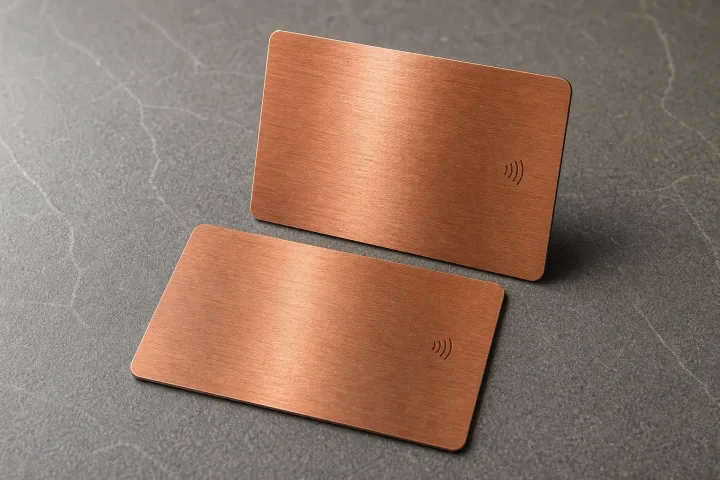
Visual character Distinct red-orange copper metal with directional brushing
Surface feel Warm reflective brushed copper finish
Best contrast Laser etch, black UV, dark brown marks, white code panels
QR / serial Use printed contrast panels and approve scan distance on the finished sample
RF route LF, HF/NFC, standard and high-security HF routes, selected UHF by reader test
Reader approval Test against the exact phone, lock, gate, or desktop reader
Edge options Rounded CR80 edge, chamfer control, dark RF layer by build
(FAQ) — Common questions

Copper: what buyers ask.

01Does a copper RFID card oxidise?

Yes — copper develops its surface faster than any other face in the range. Programs either specify a protective clear route to hold the bright red-metal tone, or treat the patina as part of a limited edition's character. The decision is made on a physical sample.

02What are copper RFID cards best for?

Limited editions by nature: launch events, club invitations, product authentication, collectibles, and gifts where the distinctive red metal is part of the story. There is no minimum order, which suits short collectible runs.

03Which marks stay readable on copper?

Dark marks and printed white QR panels. Because the surface tone shifts with light and age, data zones are approved by scanning the finished sample rather than judging a screen proof.

(06) — Quote Copper

Send quantity, chip, finish and encoding requirements.

Engineered antenna pathFerrite or hybrid RF structureLaser and deep engravingBrushed, plated, coated finishesUID, NDEF, and access encodingSample kits and production approval